Computational Text Analysis and
Social Media Research using R
Justin Chun-ting Ho

Learning Objectives:
- Basic R (Day 1 & 2)
- Collecting social media data (Day 3)
- Analysing text using R (Day 4 & 5)
(Realistic) Learning Objectives:
- Know what software and packages are available for various research tasks
- Copy and paste a chunk of codes and make it work
- Read documentation and R scripts so that you can further your learning independently

Introduction to R
R & R Studio

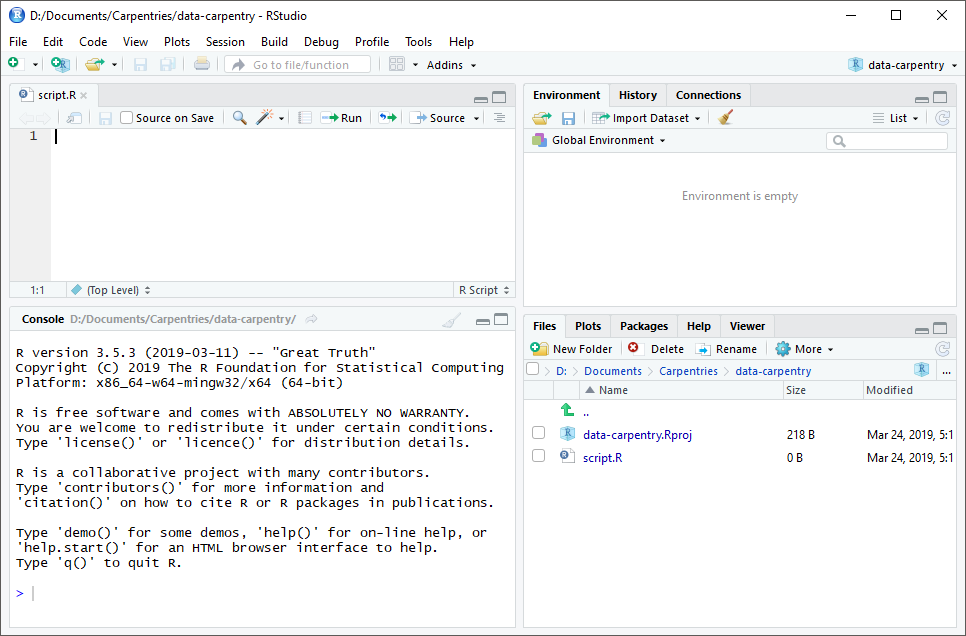
Create a new project
- Under the File menu, click on New project, choose New directory, then New project
- Enter a name for this new folder, and choose a convenient location
- Click on Create project
- Create a new file where we will type our scripts
Interaction with R
- Type commands directly into the console and press 'Enter'
- Execute commands directly from the script editor using 'Ctrl' + 'Enter' ('Cmd' + 'Return' for Macs)
Tidyverse
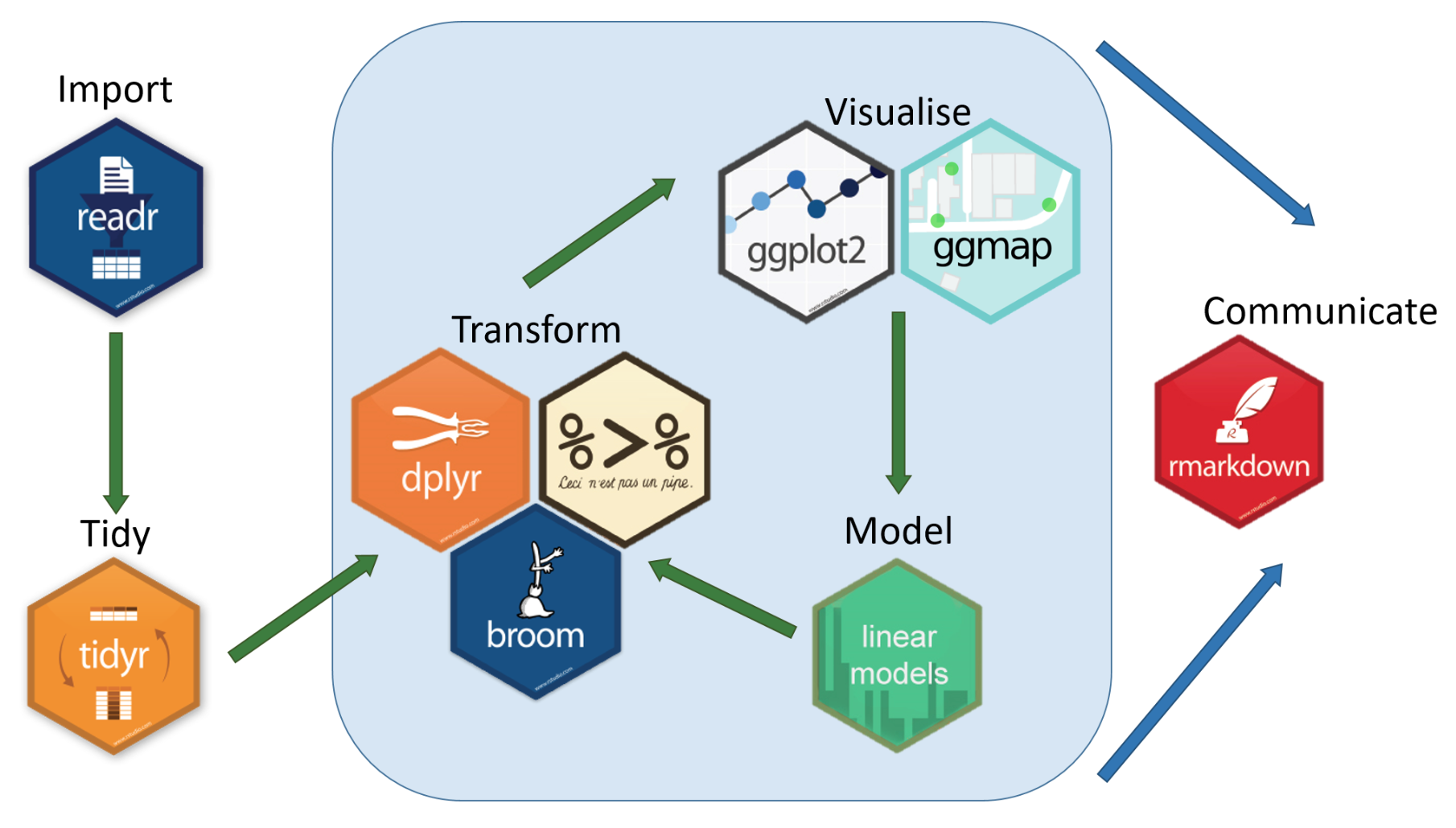
%>%

Grammar of Graphics

Collecting Social Media Data
What is an API?
Documentations:
Warning!
- API is NOT designed for research's purposes!
- What you can get depends on the platform's mercy!
- It is prone to error and bias!
Available Endpoints and Limitations
Facebook:
- Graph API: Public pages data only (no personal profile); Maximum of 600 posts per page per year; Known bias exists (See: Ho, 2020)
- CrowdTangle: Public Facebook pages and Instagram accounts; Limitations on type of data; Available to university researchers on selected topics only
Twitter:
- Search API: Limited to tweets published in the past 7 days
- Streaming API: ~2% of Twittersphere; Known bias exists (See: Morstatter et al., 2014)
- Academic Research Product Track: Available to academic researchers only; Full-archive access; Sounds too good to be true
Conclusion:
- Know what you can (can't) get
- Collect data while you still can
(it might not be the case tomorrow) - Observe Terms of Service
(and other platform's restrictions)
Time for Data Collection
Text Analysis: The Basics
“Systematic, objective, quantitative analysis of message characteristics" Kimberly A. Neuendorf, The Content Analysis Guidebook
Types of Text Analysis
Degree of human involvement:
- Human coding (100%)
- Supervised
- Unsupervised (0%)
Type of Objective:
- Scaling
- Classification
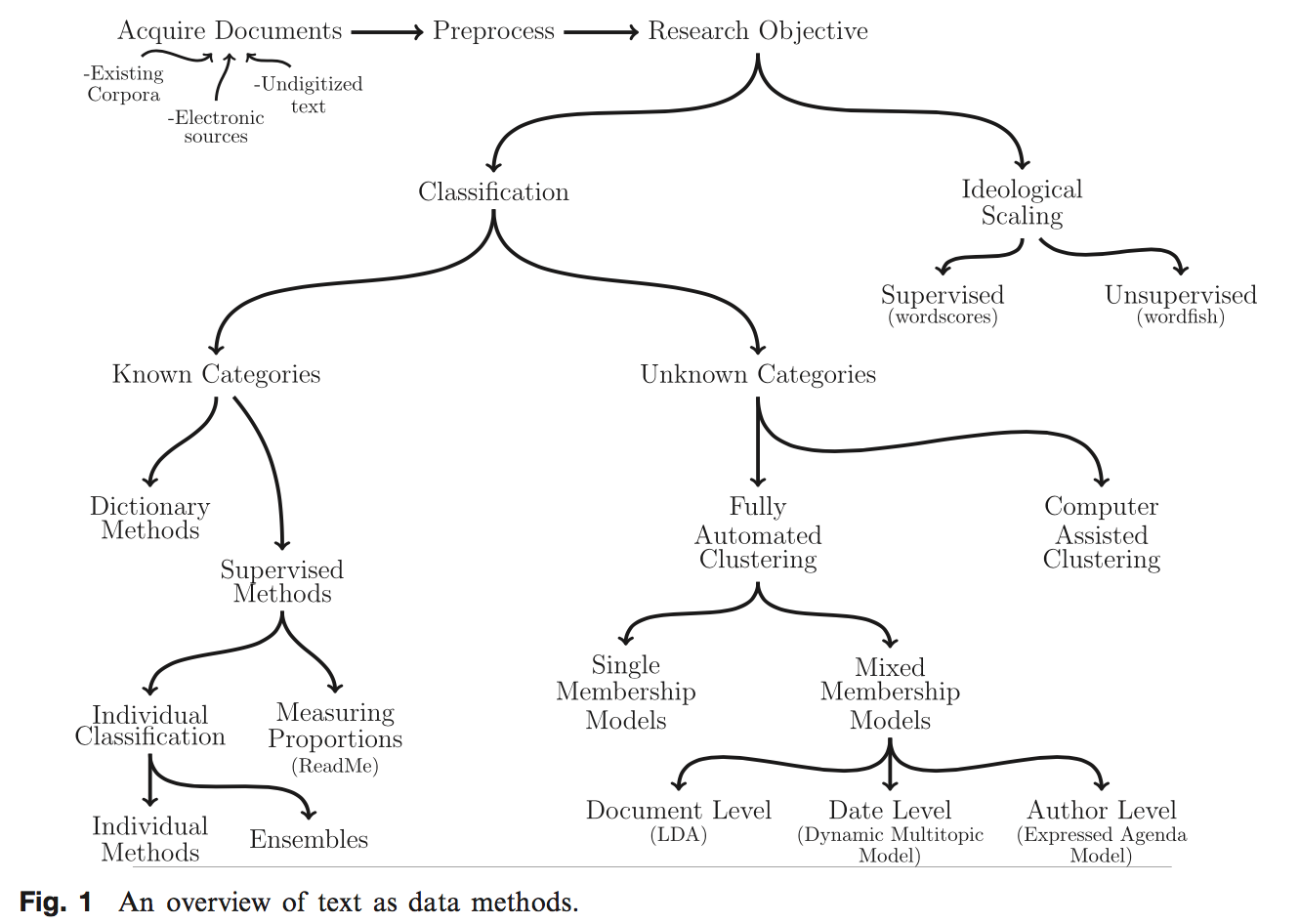 (Source: Justin Grimmer and Brandon Stewart, 2013)
4 Principles of Text Analysis
(Read: Grimmer, J. and Steward, B. (2013). Text as Data: The Promise and Pitfalls of Automatic Content Analysis Methods for Political Texts. Political Analysis, 21(3), 267-297. doi:10.1093/pan/mps028)
1. All Quantitative Models of Language Are Wrong —But Some Are Useful
- Data generation process for any text is a mystery
- All methods necessarily fail to provide an accurate account of the data-generating process
- Meanings change drastically: “Time flies like an arrow. Fruit flies like a banana.”
2. Quantitative Methods Augment Humans, Not Replace Them
- Text Analysis will not eliminate the need for careful thought nor remove the necessity of reading
- Rather than replace humans, computers amplify human abilities
3. There Is No Globally Best Method for Automated Text Analysis
- Different research questions and designs need different models
- The same model will perform well on some data sets, but poorly on other
4. Validate, Validate, Validate
- Results can be misleading or simply wrong
- Supervised methods: able to reliably replicate human coding
- Unsupervised methods: the measures are as conceptually valid
Bag of Words Assumption
- Word order doesn’t matter
- The followings mean exactly the same:
- I enjoy eating food and being with my family
- I enjoy eating my family and being with food
- and being eating enjoy family food I my with
The Output
Time for R
Keyword Analysis
Keyword Analysis
What is a Keyword?
“A keyword may be defined as a word which occurs with unusual frequency in a given text. This does not mean high frequency but unusual frequency, by comparison with a reference corpus of some kind”
(Scott, M. (1997). PC analysis of key words - and key key words. System, 25(2), 233-45.)Keyword Analysis
What is Keyness?
“The keyness of a keyword represents the value of log-likelihood or Chi-square statistics; in other words it provides an indicator of a keyword’s importance as a content descriptor for the appeal.”
(Scott, M. (1997). PC analysis of key words - and key key words. System, 25(2), 233-45.)Keyword Analysis
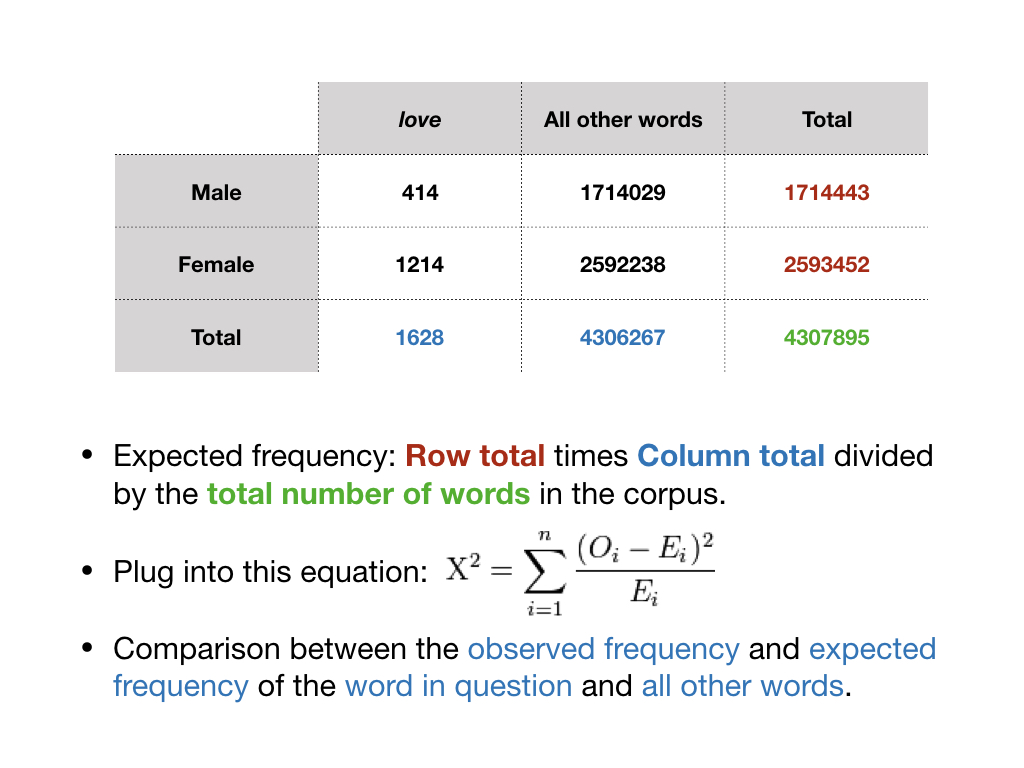
What is a Chi-squared test?
Comparison between the observed frequency and expected frequency.
Time for R
Sentiment Analysis

What is Sentiment Analysis?
Sentiment analysis, also called opinion mining, is the field of study that analyzes people’s opinions, sentiments, evaluations, appraisals, attitudes, and emotions towards entities such as products, services, organizations, individuals, issues, events, topics, and their attributes.
What is Sentiment?
- Opinions (Good vs Bad)
- Emotions (Happy vs Sad)
- Attitudes (Like vs Dislike)
Levels of Analysis
- Document level
- Sentence level
- Entity and Aspect level
Examples of Usage
- Product Review
- Public Opinion
- Voters Support
- Wellbeing/Mental Health
Lexicons
- "Dictionary" for sentiment
- Popular Lexicons:
- LIWC
- Lexicoder Sentiment Dictionary (postive, negative)
- AFINN (postive to negative from +5 to -5)
- Bing (postive, netgative)
- NRC (postive, netgative, anger, anticipation, disgust, fear, joy, sadness, surprise, trust)
Challenges
1. Opposite orientations in different applications.
“This camera sucks.” vs
“This vacuum cleaner really sucks.”
Challenges
2. Sentence containing sentiment words may not express any sentiment.
“If I can find a good camera in the shop, I will buy it.”
Challenges
3. Sarcastism
“What a Genius! You uploaded your passwords to Github!”
Note: Very common in political discussion, especially on social media.Challenges
4. Sentences without sentiment words can also imply opinions.
“This car burns a lot of fuel.”